

MEED takes a deep dive into the developer’s approach to delivering resource-efficient projects
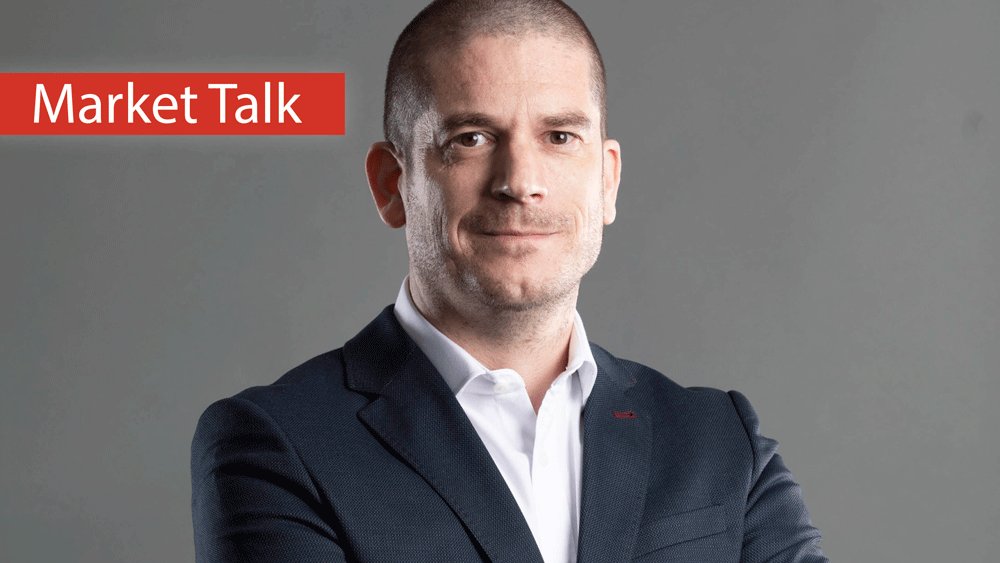
In conversation with Robbie McBratney, executive director of design management and engineering at Roshn
 1. How does Roshn define resource efficiency in the context of its developments, and what guiding principles shape your approach to responsible resource use?
For Roshn, resource efficiency begins long before ground is broken. “There’s a balance between having a buffer in a design that allows you flexibility in the future and making sure that your design is efficient — so that you are only delivering what is needed to serve the project,” McBratney explains. “That means things like ensuring medium voltage (MV) cable loops are the correct length, or that pipe sizing is done to the correct diameter. Simple things like that.”

This philosophy of “just enough” eliminates overuse of materials, helps control costs and reduces environmental impact. But Roshn’s efficiency push is not just about smart design – it is also about smart delivery.
“The second part is about rapid construction,” McBratney says, pointing to the company’s embrace of modern methods of construction and prefabrication.
“Roshn has recently inaugurated one of the largest, if not the largest, precast factories in the GCC with China Harbour. It’s located on our project site, and it enables us to reduce our carbon footprint by cutting down on transportation and reducing wastage by centralising production. Everything is delivered within our own project boundary.”
2. What strategies or technologies is Roshn implementing to reduce energy, water and material consumption across the entire project life cycle, from design to operation?
Roshn’s approach to sustainability is embedded across the entire life cycle of its developments — from early-stage design through to post-occupancy operation. The company has implemented a number of design policies aimed at reducing energy, water and material consumption.
“There are various methods we’re using,” McBratney says. “Water-saving devices, energy-efficient systems and increasing U-value thermal ratings within the home. These measures make our projects more efficient and sustainable in the long term.”
Importantly, these measures are baked into the design mandates given to consultants and contractors from the outset – a move that ensures sustainability does not come at the expense of cost-effectiveness.
“We are a profit-driven company, so we need to ensure it is cost-efficient,” McBratney explains. “That’s why we don’t just tender projects and award the lowest bidder. We enter into negotiations and partnerships with our supply chain. They often know what’s available in the market better than we do – so by partnering with them, we identify the most cost-effective way to deliver the sustainability policies we’ve committed to.”
3. How does Roshn ensure that sustainability and resource efficiency are embedded into construction practices without compromising cost-effectiveness or quality?
Local sourcing and circular economy principles are integral to Roshn’s resource-efficiency strategy. The company has adopted a local content policy that is not only aligned with Saudi Arabia’s broader industrial development goals but also helps reduce emissions and boost the domestic economy.
“We actively go out and source local providers,” says McBratney. “Roshn isn’t building extremely complex structures. We’re building housing – so it’s relatively easy for us to source things like doors, door handles, windows and sanitary ware from local markets.”
Still, he acknowledges the current capacity constraints in the local supply chain, particularly for components like precast concrete. That is why Roshn is also taking matters into its own hands. “The reason we brought in China Harbour to build the precast factory is because local precast manufacturers were already at capacity. They could deliver for us, but not at the speed we require.”
Looking ahead, McBratney hints at more strategic partnerships with local manufacturers. “Going forward, you’ll see Roshn enter partnerships where we’ll have dedicated suppliers just for us. The scale of Roshn is such that we need thousands of toilets and doors. We have to enable localisation and I believe there’s a responsibility on us to be part of that story.”
4. What role do partnerships, local sourcing and circular economy principles play in Roshn’s efforts to optimise resource use and minimise environmental impact?
While Roshn is focused on growing domestic capacity, it has not gone unnoticed by international players. “We just attended the Public Investment Fund Korean Business Forum in Seoul, and there was huge interest from suppliers wanting to enter the market,” says McBratney. “But we also want to ensure that we don’t just rely on overseas suppliers – it’s about striking the right balance and helping local businesses grow with us.”
5. Can you share measurable outcomes or benchmarks that demonstrate how Roshn’s projects are achieving or exceeding resource efficiency goals compared to traditional developments?
When it comes to measuring success, McBratney emphasises speed and delivery over technical benchmarks. “The most obvious measurable outcome is that we’re delivering units faster,” he says. “We launched a construction contract, and just over two years later, we had people living in those homes. We delivered the first neighbourhood in just over two years.”
That pace of delivery is significant not just for Roshn, but for Saudi Arabia’s broader Vision 2030 goals of rapidly expanding quality housing stock.
“In my opinion, that’s as measurable as it gets,” he adds. “Nearly 1,000 families are already living in Roshn communities. We’re the first company to make money for the Public Investment Fund. That’s the kind of performance that speaks for itself.”
Due to the presence of an onsite precast factory, Roshn estimates to save up to SR5m ($1.3m) a year through reduced delivery distances. Project delivery is accelerated by up to 15%, and transport emissions are reduced by about 2,000 tonnes of carbon dioxide a year through decreased haulage distances.
Published in partnership with

You might also like...

UAE's e& exits Vodafone in $5.95bn share sale
10 July 2026

Projects market holds its nerve
10 July 2026
Malaysian contractor wins $227m Abu Dhabi project
10 July 2026



A MEED Subscription...
Subscribe or upgrade your current MEED.com package to support your strategic planning with the MENA region’s best source of business information. Proceed to our online shop below to find out more about the features in each package.