


Connected and protected: Real-time monitoring, AI-powered analytics and connected worker solutions are changing how safety is managed on operational sites. What was once reactive is now predictive – ushering in a new proactive safety culture across the energy sector
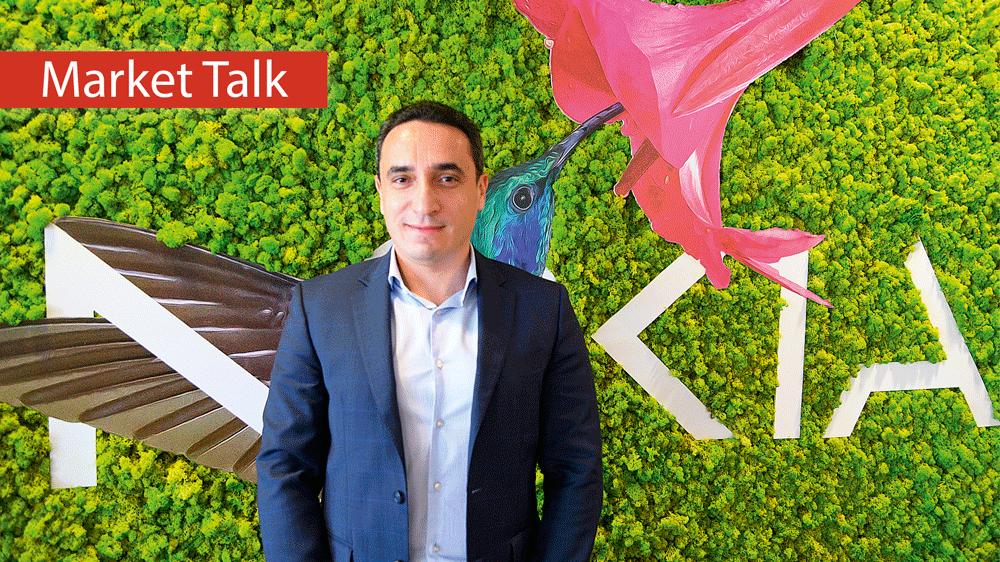
In conversation with Mahmoud El-Banna, Head of Enterprise IMEA Sales
 Could you describe the oil and gas industry’s journey in adopting digital technologies, highlighting key challenges and how these are being navigated to achieve a strategic outcome?
The oil and gas industry is under pressure to improve its operational efficiency, productivity KPIs and environmental credentials. Many organisations have taken the first step towards digitally transforming their business, using robust, reliable 4G and 5G private wireless, which Wi-Fi can complement in certain areas for an extra capacity boost, to deliver mission-critical asset connectivity and access operational data. These companies are beginning to produce and collect the massive amounts of data that AI needs to thrive, but they must be able to access it in a cohesive, uniform and timely way.
The challenge lies in the number of systems that companies rely on. Systems that leverage different communications protocols don’t speak the same language, meaning manual effort is required to analyse data and manipulate it into a standard format to identify potential hotspots. Delays occur when relying on manual inspections, which can take days to weeks to complete.
Leveraging AI to analyse and act on data across your systems and use it to automate and orchestrate operational issues detection, analysis and repair can only be achieved by collecting, harmonising and analysing comprehensive, real-time data from across your plant. This represents the next level of industrial digitalisation and must incorporate a unified, ecosystem-neutral industrial edge computing platform that integrates into existing technology environments.
Beyond implementing digitalisation solutions, how have technologies like connected worker solutions or real-time monitoring fundamentally changed the safety culture and day-to-day behaviours on oil and gas companies’ operational sites?
The more real-time information and intelligence oil and gas plants use to protect workers, the safer they are. In a recent study with GlobalData and Nokia, statistics showed that 90% of enterprises see an increase in worker collaboration of 10% or more.
As oil and gas organisations start to scale and innovate with digitalisation, these benefits will start to grow exponentially, helping organisations to remain competitive, lower their environmental footprint, and overcome challenges such as workforce skills and shortages. They have a plethora of technologies at their disposal to transform how they operate, for example:
- Remote drone inspections to reduce truck rolls and fuel consumption, and keep workers away from hazardous areas
- Critical worker communication to improve collaboration, efficiency and facilitate remote expert support, which also reduces the need for on-site travel.
Nokia recently launched a series of AI-enabled products which contribute significantly to improving worker safety such as:
- OT-compliant GenAI solution for connected workers (MX Workmate): MX Workmate leverages GenAI LLM technology to enhance human-machine interaction in critical OT environments. It provides workers with easy-to-understand, natural language-based communication that supports their daily tasks by offering real-time operational insights, contextually relevant information, and actionable alerts during emergency situations.
- AI-powered contextual awareness (MX Context): MX Context combines multimodal sensor fusion and AI inferencing to integrate OT data from different sources, delivering actionable insights, predictive recommendations, and possibilities for intelligent automation in Industry 4.0 use cases such as worker safety and asset tracking.
- AI-powered asset tracking (Nokia Visual Position and Object Detection): Using real-time video feeds and AI-powered video analytics, Nokia Visual Position and Object Detection enables real-time tracking and positioning without the need for physical tags and can be trained to detect anything on-site – making it a key enabler for improved worker safety and location tracking of critical industrial equipment.
Could you provide a few key use cases involving remote operations or automation that were not feasible prior to the deployment of a private 4.9G/LTE or 5G network?
4G/5G private networks have been rapidly evolving to represent the connectivity solution of choice for oil and gas organisations. They offer pervasive and deep connectivity that allows for easy connection of all OT assets while maintaining the deterministic performance and reliability needed for OT.
Private wireless networks offer a range of scalability to match all deployment sizes and requirements. Some of the key use cases that are unique to Private 4G/5G networks deployments over legacy technologies are:
Industry 4.0 & Automation – Oil and gas organisations are investing in digital automation and robotics, driving demand for low-latency wireless. Use cases include Robotics in oil fields and plants and real-time video inspection.
Security & Reliability – Oil and gas seek dedicated, secure networks to avoid Wi-Fi/public network vulnerabilities, which are critical for sensitive operations.
Edge Computing Integration – On-prem industrial edge is being adopted alongside private wireless to enable AI analytics in real time (e.g., video analytics improving efficiency by ~10%)
Sustainability & Worker Safety – Private wireless enables connected sensors and drones, reducing emissions and enhancing safety, e.g., improved monitoring reduces truck rolls by ~10% in emissions
Could you explain a situation in which improving an operation or averting an incident depended critically on the capacity to handle data at the edge instead of in the cloud?
Leveraging an industrial edge, enterprises can overcome the hurdles of unifying old and new assets to gain a holistic view of operational data and deliver support for Gen AI. It allows data to be processed and analysed in real-time, on-premises, and made available for consumption by applications for process optimisation through predictive maintenance, automated alerts, and more.
By implementing a digitalisation platform that incorporates robust, reliable connectivity including devices (cameras/sensors/gateways) that are providing inputs through the mission-critical network, and an on-premises industrial edge, oil and gas operators can harness the full power of AI across a fully connected operation. They can stay ahead of operational challenges, reduce costs, enhance safety, and avoid the environmental damage that can occur through leaks. This isn’t a vision of the future; companies can begin using an industrial edge computing platform as an integral part of their digitalisation journey today. Those who act now will gain the competitive advantage.
Using AI to continuously monitor and analyse data from industrial equipment to detect patterns, for example, in pressure, temperature, or flow rates, oil and gas companies can optimise delivery, detect leaks and isolate sections automatically, and schedule predictive maintenance and general maintenance windows. AI can identify workarounds while situations are being managed, to limit the impact on customers and the environment and protect workers.
How might oil and gas companies use advanced technologies to improve operational efficiency and sustainability while accelerating their transition to managing renewable assets?
Industry 4.0 digitalisation and high-performance connectivity are critical accelerators for more sustainable industrial operations. With considerable environmental footprints and the need for consistent, transparent reporting, industries are increasingly measuring and tracking the progress of their sustainability strategies. In support of industries’ sustainability goals, we have recently launched the Private Wireless Sustainability Calculator.
Our Private Wireless Sustainability Calculator quantifies the environmental and social benefits of private wireless networks, industrial edge and four critical Industry 4.0 use cases, such as environmental monitoring. It’s a powerful tool that offers vital findings and insights to improve operational efficiencies, worker health and safety, and potential reductions in costs and environmental footprint. The calculator model uses data from multiple sources and is currently available for use by multiple industries.
From your point of view, what is the most difficult component of guiding digitalisation transformation for an oil and gas company?
The oil and gas industry’s traditionally risk-averse culture can be a significant barrier to digital adoption. Embracing change and building trust in new technologies are essential to unlocking the full value of digital transformation. Without this cultural shift, even the most advanced tools may go underused or be met with scepticism.
Building a culture that welcomes digital initiatives requires deliberate effort across all levels of the organisation. Leadership must not only endorse digital strategies but also actively model openness to change. Celebrating small wins, such as successful pilot projects or process improvements, creates positive momentum and demonstrates tangible benefits, reducing resistance over time.
Employee involvement is also key. When teams participate in shaping how digital tools are adopted and adapted, they develop ownership and a sense of agency rather than feeling that change is imposed upon them. Transparent communication about goals, expectations, and how digital transformation aligns with both individual and organisational success helps build trust.
Moreover, fostering a learning mindset, where experimentation is encouraged and failure is seen as part of progress, can break down the fear of the unknown. Training programmes, peer learning and easily accessible support with team champions empower employees to grow their digital skills confidently.
Ultimately, the technology itself is only part of the equation. A resilient, adaptable culture that values innovation and continuous improvement lays the foundation for sustainable digital success.
To learn more, please click here
Published in partnership with

You might also like...



A MEED Subscription...
Subscribe or upgrade your current MEED.com package to support your strategic planning with the MENA region’s best source of business information. Proceed to our online shop below to find out more about the features in each package.