

Foreign staff have left the site of the project to develop the Akkas gas field


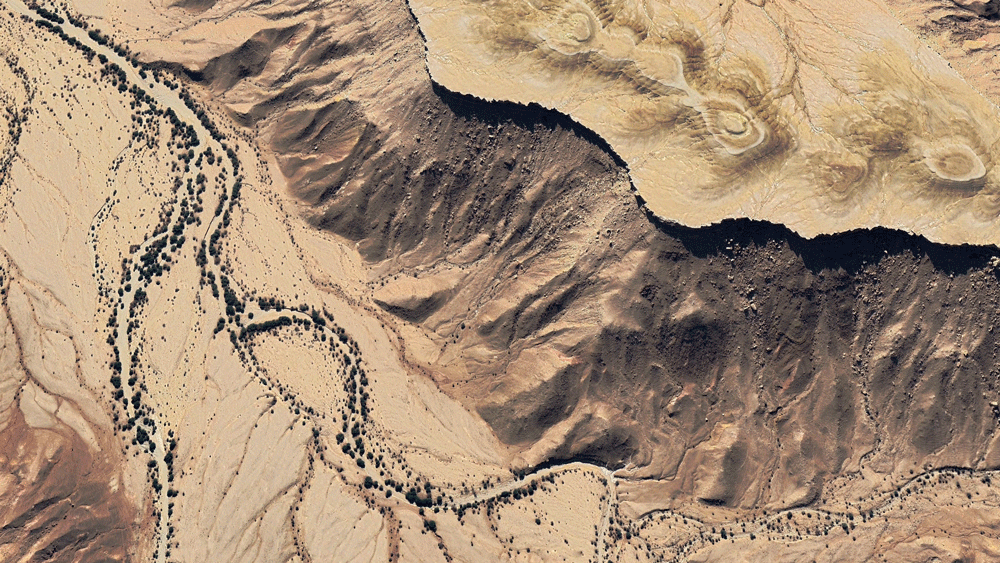
Progress on Iraq’s project to develop the strategically important Akkas gas field has been disrupted by security issues related to the US and Israel’s ongoing war with Iran, according to industry sources.
Work activity at the project site has been significantly reduced due to security concerns, and the project is now expected to take longer to complete.
Iraq held a ceremony in January this year to mark the restart of drilling operations at the site as part of the field development project.
In July last year, Iraq’s Oil Ministry announced signing a contract with the US-based oil field services provider SLB to develop production at Iraq’s Akkas gas field.
Under the terms of the deal, SLB will drill wells at the Akkas field, aiming to initially raise production to 100 million cubic feet a day (cf/d).
Many of SLB’s non-Iraqi employees have now been evacuated from the country.
Over the long term, Iraq is targeting gas production of 400 million cf/d from the field.
The contract with SLB replaces a previous deal with Ukraine-based Ukrzemresurs, which has been terminated.
It also covers the construction of surface infrastructure and pipelines to connect Akkas to central processing units.
The gas produced at Akkas will be used to fuel the Anbar combined-cycle power plant, which is under construction by the Electricity Ministry.
Akkas gas field development
The Akkas gas field, located in Anbar province in western Iraq, has 5.6 trillion cubic feet of proven reserves. The field was discovered in 1992 and began production in 1993.
Since then, Iraq’s plans to develop the Akkas gas field to its full potential have experienced several setbacks.
In April last year, the Iraqi Oil Ministry signed an agreement with Ukrzemresurs to develop the field.
At the time, the Oil Ministry said that the partners were aiming to produce 100 million cf/d in the first two years, as per the agreement, with output targeted to increase to 400 million cf/d within four years.
Prior to Ukrzemresurs, South Korean company Kogas was responsible for developing the field.
Rights to the field were originally awarded to a consortium of Kogas and Kazakhstan’s state-owned oil company KazMunaiGas (KMG) in the third licensing round, which was launched in October 2011.
KMG pulled out, leaving Kogas as the sole investor and operator on new contract terms.
When the deal with Ukrzemresurs was originally announced last year, it was negatively received by some Iraqi politicians, with the Oil and Gas Committee in Iraq’s parliament rejecting the contract signing.
At the time, Ali Al-Mashkour, a member of the Oil and Gas Committee, told Iraq’s Shafaq News Agency: “This contract involves a great waste of Iraq’s wealth, and there will be a waste of Iraq’s oil, and this confirms that Iraq is once again failing to choose reputable companies to work with in the most important economic field in the country.”
He added: “We will work to uncover and expose the suspicions in this contract during the next stage, especially since this contract was made by some representatives for specific interests, which we will reveal soon with evidence.”
Plans to sign the contract to develop the Akkas gas field with a Ukrainian company were first announced by the Oil Ministry in September 2023, but Ukrzemresurs was not named at the time.
Iraq’s government is trying to transform the country into a gas-exporting nation. Currently, Iraq is reliant on Iran for gas imports.
Both Saudi Arabia and the US, which are looking to contain Iranian influence in the region, have been supporting Iraq in developing its non-associated gas fields as this will reduce Iraq’s economic reliance on Iran.
You might also like...

Trump pauses strikes on Iran energy plants
27 March 2026
Libya pipeline expected to take ten days to repair
27 March 2026
Iraq expects to increase northern pipeline oil exports
27 March 2026

A MEED Subscription...
Subscribe or upgrade your current MEED.com package to support your strategic planning with the MENA region’s best source of business information. Proceed to our online shop below to find out more about the features in each package.