


Environment, social and governance principles have become a defining element of the bank’s investor relations
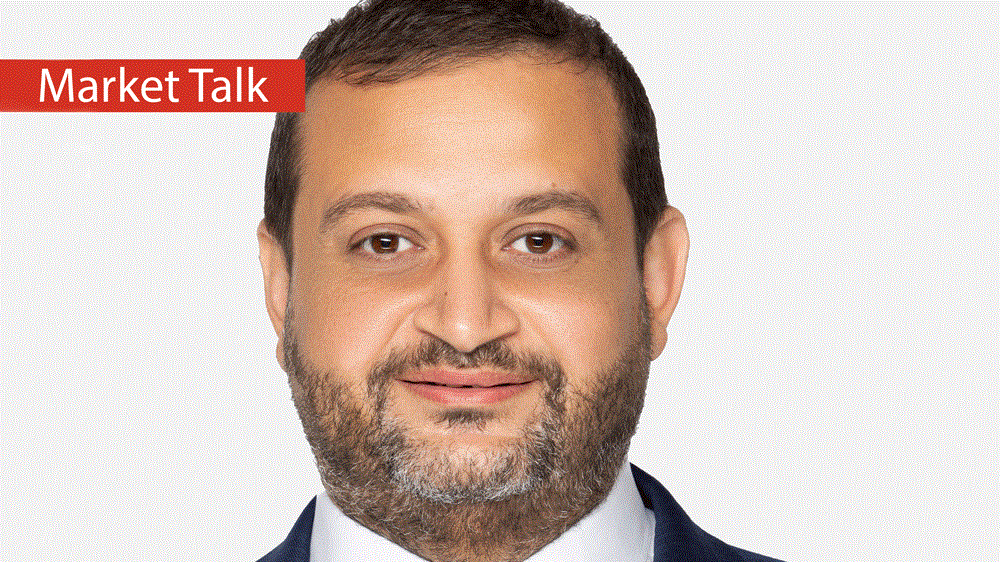
In conversation with Amir Hanna, group chief communications officer at National Bank of Kuwait
 National Bank of Kuwait (NBK) has achieved top-tier environment, social and governance (ESG) ratings in the Middle East and North Africa. What changes underpinned this performance and how are you ensuring these gains are sustained?
NBK’s recognition as a top-tier ESG performer in the region reflects a governance model that aligns with global best practices and is driven by our senior leadership. NBK has embedded sustainability oversight at the highest level, through a board-endorsed Sustainability & Climate Change Committee. It has clear accountability and is supported by cross-functional sub-committees that embed sustainability into the bank’s culture and operational activities. Senior leadership actively supports ESG integration, ensuring alignment with international frameworks such as the International Financial Reporting Standards – International Sustainability Standards Board, the Task Force on Climate-related Financial Disclosures and the Partnership for Carbon Accounting Financials.

NBK’s approach combines rigorous policy oversight with robust stakeholder engagement, pragmatic climate risk management and a disciplined allocation of capital to sustainable finance initiatives, exemplified by its landmark $500m green bond and $5bn sustainable assets portfolio by year-end 2024.
By coupling governance with strong management sponsorship, NBK is ensuring its ESG performance is structurally embedded, resilient to market shifts and positioned to deliver sustained impact to our stakeholders and shareholders.
NBK issued Kuwait’s first green bond in 2024. What did the experience reveal about the future of sustainable finance?
NBK’s issuance of Kuwait’s first green bond in 2024, valued at $500m, marked a pivotal moment for the country’s sustainable finance landscape. Oversubscribed more than three times, it underscored strong investor participation from a highly diversified global investor base spanning the US, the Middle East, the UK, Europe and Asia. This reception clearly demonstrated investor demand for credible, transparent, well-structured green instruments aligned with global sustainability standards and market principles.
Equally important, NBK enhanced internal capabilities, strengthening the governance framework for project selection, impact reporting and independent verification, while fostering cross-collaboration across key internal stakeholders. Reinforcing its commitment to transparency, the bank published its first Green Bond Allocation and Impact Report in May 2025. The report, externally verified against our Sustainable Financing Framework, demonstrated measurable and tangible environmental outcomes from an eligible green asset portfolio totaling $625m, exceeding the bond’s size. This combination of market validation, transparency and tangible environmental results positions NBK as a driving force, contributing to the sustainable finance market of the country and of the wider region.
Looking ahead, NBK anticipates robust growth in sustainable finance, driven by tightening ESG regulations and evolving investor preferences. Sustainable finance is expected to move beyond compliance to become a driver of economic diversification, positioning the GCC states as competitive gateways for global ESG capital and investments. The bank is poised to expand its portfolio of green and transition finance solutions, enabling clients to accelerate low-carbon, climate-resilient strategies, while cementing its leadership role in driving the GCC’s sustainable economic transformation and diversification.
How is ESG influencing investor relations and shaping funding strategies or capital allocation at NBK?
ESG has become a defining element of NBK’s investor relations, shaping both the bank’s market engagement and its capital allocation strategy. Strong ESG ratings and transparent reporting have enhanced investor confidence, with sustainability now embedded in regular communications to shareholders.
The launch of NBK’s Sustainable Financing Framework has formalised this integration, ensuring funding decisions and capital allocations are directed towards clearly defined green, climate mitigation projects under robust governance and independent verification. This approach has translated into tangible growth in the bank’s sustainable assets portfolio, with sustainable loans alone reaching $2.52bn as of year-end 2024, complemented by the green bond issuance. Together, these developments reflect a deliberate shift in our funding strategy, where ESG commitments are drivers of capital deployment.
How do you adapt NBK’s sustainability strategy to its diverse markets?
NBK’s ESG strategy is built on a global framework but flexibly tailored to each of our markets’ regulatory environments, stakeholders’ expectations and economic priorities. We maintain consistent governance standards, disclosure practices and alignment with frameworks, ensuring credibility with global investors. From there, we adapt the emphasis; in markets with mature ESG regulations, we deepen alignment with local taxonomies and reporting requirements, while in emerging markets, we prioritise building internal and client capabilities, strengthening data collection and developing tailored financing solutions that help catalyse transition opportunities in key climate-sensitive sectors. This dual approach ensures we remain globally consistent with local adaptability, enabling NBK to advance sustainable growth in the markets in which it operates.
What role do you see NBK playing in advancing the sustainability agenda in Kuwait and the wider Gulf?
NBK is committed to becoming a catalyst in advancing the sustainability agenda in Kuwait and across the GCC. Domestically, we aim to scale green and transition lending, pioneering innovative instruments such as green lending and sustainability-linked loans, and maintaining market transparency through rigorous allocation and impact reporting. We see our role as extending beyond financing, working side-by-side with our clients to understand their transition needs, co-creating tailored ESG solutions and helping them meet evolving regulatory and investor expectations.
Across the GCC, we will leverage the bank’s regional network to enhance alignment with emerging sustainable finance taxonomies and channel capital into priority areas such as renewable energy, sustainable infrastructure and low-carbon industrial transformation.
Importantly, we recognise that digital transformation is a critical enabler, creating innovative client services that integrate sustainability into digital banking. By combining close client partnerships, sustainability leadership and digital innovation, NBK aims to be both a capital provider and a trusted advisor in shaping the region’s low-carbon, climate-resilient and tech-enabled economy, aligned with Kuwait Vision 2035 and the GCC’s net-zero ambitions.
Published in partnership with

You might also like...

UAE's e& exits Vodafone in $5.95bn share sale
10 July 2026

Projects market holds its nerve
10 July 2026

Malaysian contractor wins $227m Abu Dhabi project
10 July 2026




A MEED Subscription...
Subscribe or upgrade your current MEED.com package to support your strategic planning with the MENA region’s best source of business information. Proceed to our online shop below to find out more about the features in each package.