
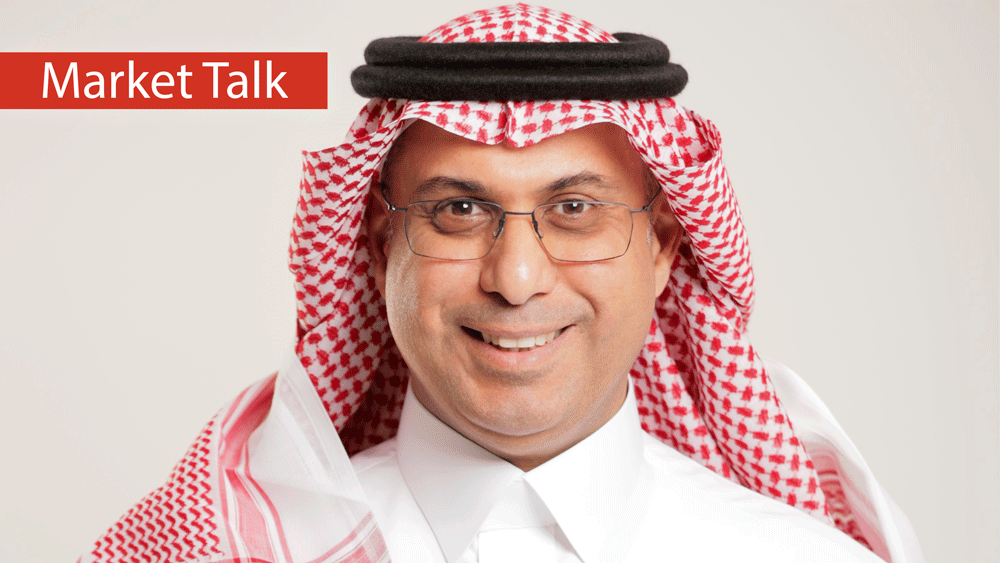
As Saudi Arabia strengthens its position within the global trade system, Saudi Export-Import Bank (Saudi EXIM) is a strategic pillar supporting this transformation
In conversation with Saad A AlKhalb, CEO of Saudi EXIM
 How does Saudi Export-Import Bank (Saudi EXIM) determine which sectors, regions or exporter types to prioritise in its financing and guarantee programmes?
Saudi EXIM follows a precise strategic methodology aligned with Vision 2030, particularly the goal of increasing the share of non-oil exports from 16% to 50% of non-oil GDP. This methodology is integrated with national economic and development strategies.
Operating within the broader ecosystem of the Industry & Mineral Resources Ministry, the bank plays a key role in advancing the goals of the National Industrial Strategy, with particular emphasis on developing priority sectors. In line with its principle of integration with the Saudi Export Development Authority, the bank also aligns its efforts with the target sectors and markets to drive export growth.
Geographically, the bank is implementing tailored projects using advanced sectoral analysis tools to build a targeted market map. Saudi EXIM also participates in major international events such as Global Trade Review and Trade & Export Finance conferences.
The bank also prioritises a range of exporter segments, with an emphasis on small and medium-sized enterprises (SMEs) and first-time exporters. In 2024, new clients accounted for 45% of total approved applications, and 30% of the bank’s services were dedicated to SMEs – reflecting a clear commitment to inclusivity in the export ecosystem.
How does Saudi EXIM align its products, partnerships and risk preparedness to support the goal of reaching $100bn in non-oil exports by 2030?
To contribute to the national target of increasing the share of non-oil exports from 16% to 50% of non-oil GDP by 2030, Saudi EXIM is executing a comprehensive strategy centred on product diversification, expanded partnerships and robust risk management.
Since its establishment, Saudi EXIM has been a key driver of sustainable economic growth and local content development. Over the past five years, it has extended more than $22bn in credit facilities. The bank has also secured an A+ long-term issuer credit rating for both foreign and local currencies from Fitch Ratings, with a stable outlook.
This approach yielded strong results in 2024, with total credit facilities reaching $8.93bn – a 103% growth compared to 2023. This included $3.19bn in direct export financing and $5.75bn through export credit insurance programmes, raising the bank’s share of total non-oil export credit facilities to 7.66%.
On the product side, the bank offers a wide array of financial services, including financing, guarantees, export credit insurance and import financing for raw materials used in value-added re-export processes. The bank continues to refine and expand this portfolio to meet evolving exporter needs.
To date, the bank has signed over 70 memorandums of understanding, along with a wide range of financing and insurance agreements, as well as partnerships with international and local banks, financial and commercial institutions, global trading houses, export credit agencies and several relevant multilateral organisations.
Milestones include partnerships with major global trading houses such as Trafigura and Glencore, a strategic reinsurance agreement with Allianz Trade to cover supply chains in over 50 countries, and a landmark letter of credit insurance agreement with Sabic — the largest of its kind in the Middle East and a regional first.
Geographically, the bank has enabled Saudi non-oil exports to reach 150 countries worldwide and aims to expand further through partnerships like the Glencore agreement, which targets over 156 high-potential markets.
The bank launched the Bridges Initiative (Jusoor) to empower Saudi manufacturers by streamlining the import of raw materials and equipment with greater speed and efficiency. This is achieved through tailored financing and insurance mechanisms, developed in collaboration with global export credit agencies and international insurance companies. Covering imports from over 70 countries, the initiative supports strategic industries such as mining, automotive, aviation and renewable energy, in full alignment with the objectives of the National Industrial Strategy.
The bank also launched several development initiatives to enhance the customer experience. In 2024, customer satisfaction rates reached 89% and application processing times improved by 88% within 45 working days. These milestones reflect the bank’s evolution from a traditional financier into a strategic enabler of global competitiveness for Saudi non-oil exports.
What is the impact of slower economic growth on exports and how does the bank respond to these challenges?
In the face of slower non-oil GDP growth, Saudi EXIM ensures flexible credit solutions to help local exporters and international buyers navigate uncertainty and mitigate risk. The bank focuses on sectors proven to be resilient through economic cycles – such as chemicals, metals, food products and construction materials.
To support exporters during challenging times, the bank intensifies its use of tools such as export finance, guarantees, export credit insurance and documentary credit insurance. It also provides import financing for raw materials and production inputs to support re-export strategies and stabilise supply chains. These efforts are backed by credit solutions that cover supply chains in over 50 countries.
Recognising shifts in global financing costs, the bank offers competitive rates to shield exporters from interest-rate volatility. It also closely monitors geopolitical risks and supply chain disruptions, continuously enhancing its risk assessment models and insurance solutions.
This proactive approach helps exporters remain competitive and ensures the steady flow of Saudi goods and services to international markets. As part of its national responsibility, the bank also launched Saudi Arabia’s first graduate development programme in export credit insurance – a guaranteed employment initiative aimed at developing a new generation of specialists in this critical field.
What are the bank’s top priorities for the second half of 2025?
In the second half of 2025, Saudi EXIM will focus on implementing strategic initiatives built around three core pillars: maximising economic impact, empowering clients and continuously improving operations – all aligned with Vision 2030.
Under the economic impact pillar, the bank is continuing its Market Access plan by refining its methodology for identifying priority markets and sectors, expanding its global footprint through new representative offices and signing agreements with development banks in key regions. It is also establishing a dedicated department for international project financing, developing service export standards and updating the regulatory and legislative framework to stimulate the financing and insurance of non-oil exports.
The bank remains committed to deepening collaboration through strategic partnerships, international memberships and global engagements aimed at advancing the global trade ecosystem. These efforts focus on addressing exporter challenges through innovative solutions while also building strong commercial ties that promote mutual interests and support national development objectives.
To empower clients, the bank is moving into phase two of its Customer Experience Transformation initiative, improving its website, setting clear eligibility criteria for all services and introducing performance and experience indicators for beneficiaries.
In terms of operational improvement, the bank is developing a unified data warehouse to support decision-making, launching a fully digital insurance system that covers the entire product lifecycle and implementing a comprehensive stress-testing framework for risk management. Additional efforts include enhancing application programming interface management, strengthening cybersecurity and introducing a standardised operational guide for financing activities.
In support of institutional capacity-building, the bank delivered 534 training opportunities for its employees and partners in 2024. It also hosted the 2024 Berne Union Country Risk Experts Meeting in Riyadh, welcoming specialists from 47 organisations in 33 countries – further positioning Saudi Arabia as a global centre for export finance.
Published in partnership with

You might also like...

UAE's e& exits Vodafone in $5.95bn share sale
10 July 2026

Projects market holds its nerve
10 July 2026

Malaysian contractor wins $227m Abu Dhabi project
10 July 2026


A MEED Subscription...
Subscribe or upgrade your current MEED.com package to support your strategic planning with the MENA region’s best source of business information. Proceed to our online shop below to find out more about the features in each package.