

Geopolitical pressures and shifting trade flows are driving banks in the region to adapt, diversify and recalibrate their approach


Ongoing uncertainty and shifts in the external environment are reshaping how banks in the region approach strategic planning. Geopolitical tensions, inflationary pressures and evolving trade alliances are causing financial leaders to challenge long-held assumptions about growth, risk and resilience - and adjust their strategies accordingly.

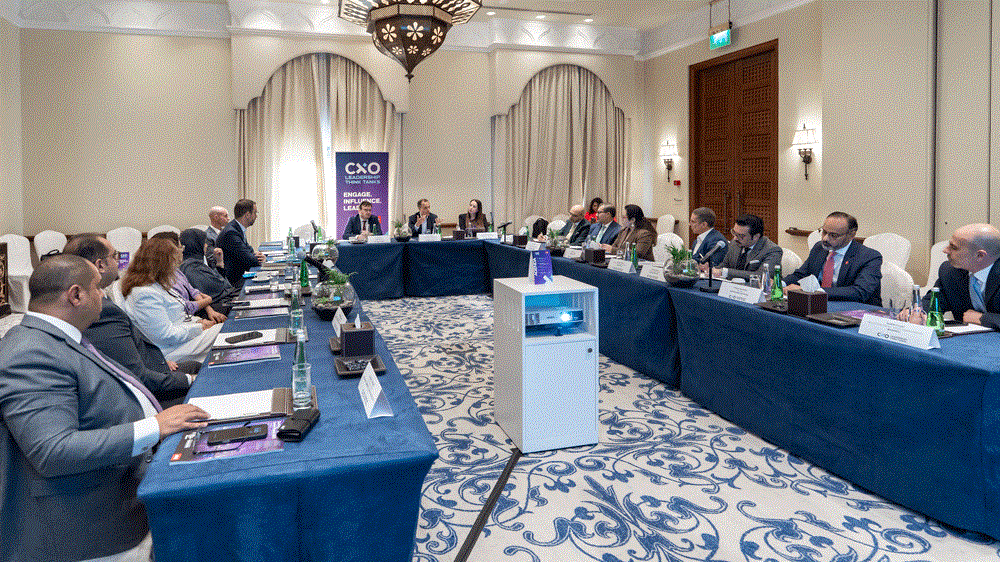
At the recent MEED CXO Leadership Think Tanks forum, held under the Chatham House Rule in Dubai, senior executives from leading regional banks, regulatory experts and economists shared insights on how banking strategies are evolving in increasingly fluid conditions. Five key priorities emerged.
1. Risk planning
Risk management in banking in the Middle East and North Africa (Mena) region is becoming increasingly forward-looking and scenario-based, driven by heightened geopolitical uncertainty. Participants in the Leadership Think Tank described the environment as “extremely fluid”, with many traditional assumptions no longer holding in a region exposed to overlapping global shocks.
Executives noted that historical models are losing relevance. Banks are shifting to dynamic contingency planning and more adaptive stress-testing frameworks to address sector-specific vulnerabilities and external pressure points. One participant remarked that it is no longer about avoiding risk, but about learning “how to steer while the road is still being built”.
Others emphasised the need to revisit continuity and disaster recovery strategies, particularly in jurisdictions with elevated political risk. The consensus was that such plans must be tested and updated regularly, regardless of how recently they were reviewed.
This shift aligns with broader trends. Financial institutions in the Mena region are facing greater operational and macroeconomic uncertainty, prompting "stronger internal buffers and more flexible scenario-based planning", according to the Washington-based IMF’s April 2025 Regional Economic Outlook.
2. Capital flexibility
Banks are increasingly treating capital and liquidity as strategic levers, not just financial cushions. At the Think Tank event, participants emphasised the importance of preserving capital and maintaining high liquidity cushions amid growing volatility. One executive noted that when the ability to predict or quantify risk diminishes, “shoring up liquidity” becomes critical to remain operationally and strategically agile.
The discussion focused on reassessing capital allocation and deferring non-essential expansion plans to prepare for continued instability. There was broad agreement that conservative capital management will be essential in navigating overlapping geopolitical, regulatory and macroeconomic risks.
This approach aligns with current financial trends. The Central Bank of the UAE’s 2024 Financial Stability Report says that systemic banks have maintained capital adequacy ratios above 17%, supported by targeted regulatory buffers designed to “address cyclical fluctuations”.
Similarly, a March 2025 report by Fitch Ratings noted that Saudi banks entered the year with solvency ratios approaching 20% and strong liquidity coverage, allowing them to absorb shocks while sustaining credit growth.
The consensus from the discussion was clear: in a high-risk environment, capital flexibility is vital for both resilience and opportunity. Banks with strong capital positions are better equipped to act when strategic openings arise.
3. Compliance strategy
The compliance function is becoming increasingly complex. Executives at the Think Tank event described a landscape where sanctions, correspondent banking requirements and regulatory frameworks are evolving rapidly and often unpredictably. One participant noted that the pace of change is so brisk that institutions must move beyond risk avoidance and instead “navigate through unpredictable events”.
The group highlighted the growing role of real-time surveillance and behavioural analytics in managing this complexity. While automation is necessary, participants emphasised the need for stronger governance in parallel. As one contributor put it, while artificial intelligence and predictive monitoring provide round-the-clock risk visibility, they also raise critical accountability concerns: “When decisions are made by systems, who owns the consequences if something goes wrong?”
These concerns are increasingly reflected in regulatory enforcement. In its Q1 2025 Financial Crime Report, the Central Bank of the UAE stressed the importance of clear accountability frameworks in automated compliance systems, warning that poor data quality and opaque ownership structures can undermine the integrity of digital controls.
The message was clear: compliance can no longer be treated as a back-office function. It must be embedded into the operational core, supported by real-time visibility, clearly defined roles and the capacity to respond immediately to emerging threats.
4. Operating agility
In an era where uncertainty is constant, agility outweighs scale. Leadership Think Tank participants emphasised the need for banks to design for change rather than stability. One technology leader noted that adaptability has become “a first principle”, requiring infrastructure that can absorb disruption rather than resist it.
The discussion focused on three imperatives: visibility, speed and structure. Executives stressed the value of real-time data access, accelerated product development and agile internal processes. One speaker summed it up: “We used to design for control, but now we design for volatility.”
This transformation is already under way. According to McKinsey’s 2024 Middle East Banking Outlook, leading institutions are moving towards cross-functional teams, shorter approval cycles and modular technology platforms to respond more quickly to shocks and opportunities. The report notes that banks in the GCC are adopting digital factories and agile sprints to drive innovation.
Participants agreed that this shift is not optional. In a volatile environment, only banks that embed agility into their systems and decision-making will be able to adapt, pivot and compete effectively.
5. Measured growth
There was broad agreement at the Think Tank event that growth strategies are becoming more cautious, focusing on alignment with client flows and risk management. Executives described a shift towards “measured growth”, where opportunities are evaluated through the lens of resilience, preparedness and long-term value.
Free trade agreements, particularly the UAE’s Comprehensive Economic Partnership Agreements (Cepa), are opening new investment corridors.
Rather than entering new markets alone, many banks are following their clients through partnerships, correspondent arrangements or targeted lending caps.
This reflects broader industry behaviour. Emirates NBD’s 2025 disclosures reveal regulatory approval to localise its India operations, deepening its position in the UAE-India corridor to support Cepa-enabled trade. A May 2025 Zawya report highlighted that other banks are similarly pursuing real-economy alignment, particularly in sectors like infrastructure and manufacturing, which are impacted by shifting supply chains.
The tone of the discussion was pragmatic: growth remains a priority, but only if banks are well-capitalised and operationally prepared. This means factoring in currency exposure, political risk and sectoral diversification.
For Middle East banks, the strategic environment is no longer about predicting the next risk but building the capacity to respond to it. Success hinges on readiness, adaptability and the ability to shift course before external pressures demand it.
You might also like...

Kuwait awards $38.8m oil services contract
16 June 2026


US and Iran sign framework peace deal
16 June 2026



A MEED Subscription...
Subscribe or upgrade your current MEED.com package to support your strategic planning with the MENA region’s best source of business information. Proceed to our online shop below to find out more about the features in each package.