



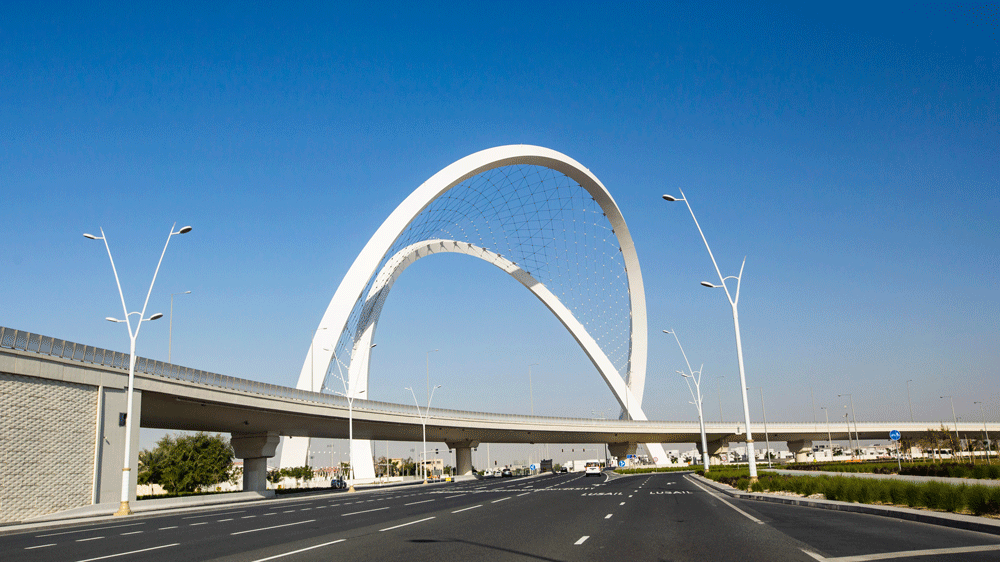
Unprecedented strike by Tel Aviv violates sovereignty of US and Nato-allied GCC state


On 9 September, Israel carried out an unprecedented airstrike in Doha, Qatar, targeting residences in one of the country’s most secure neighbourhoods, aiming to kill senior Hamas leaders who were negotiating with Tel Aviv through mediators.

The attack comes despite Qatar’s role as a key US and Nato ally in the Gulf, hosting the largest US airbase and the regional headquarters of US Central Command. In 2022, Qatar was designated a Major Non-NATO Ally (MNNA) of the US.
The attack has drawn global condemnation, including from other US allies, who expressed dismay at the violation of Qatar’s sovereignty and the lack of any credible rationale for the strike in terms of advancing regional goals.
Reportedly carried out by around 10 Israeli aircraft, the strike targeted Khalil Al-Hayya, an exiled Hamas member from Gaza, now serving as its chief negotiator and one of five members appointed to the steering committee in 2024 following the deaths of other leaders.
Hamas stated that the attack did not kill any senior leaders but instead resulted in the deaths of five members – Al-Hayya’s son, three bodyguards and an office manager — along with one Qatari serviceman.
Doha also confirmed that a member of its security forces had been killed in the attack.
Qatar responded with immediate outrage, with Prime Minister Sheikh Mohammed Bin Abdulrahman Al-Thani denouncing the strike as “state terrorism” and stating that Qatar would respond legally and diplomatically.
Majed Al-Ansari, spokesperson for the Qatari Ministry of Foreign Affairs, reiterated that Qatar would “not tolerate this reckless Israeli behaviour and the ongoing disruption of regional security, nor any act that targets its security and sovereignty”.
Qatari UN ambassador Alya Ahmed Saif Al-Thani called the strike a “cowardly criminal assault, which constitutes a blatant violation of all international laws and norms”.
Mediation at risk
Qatar also rejected initial US claims that it had received advance warning of the strike, stating instead that communication from the US came only after the attack had already begun and explosions had been heard.
In the wake of the assault, Qatar initially announced it would cease its role as mediator between Israel and Hamas – potentially an Israeli aim in conducting the strike – but the prime minister has since confirmed that mediation will continue.
Israel, meanwhile, has framed the strike solely in terms of targeting Hamas’ political leadership, detached from the context of its location on Qatari soil and the resulting Qatari casualty. As of writing, Tel Aviv has not expressed any apparent regret over the loss of Qatari life.
Israel stated that the decision to strike followed a shooting in Jerusalem that killed six people and an attack in Gaza that killed four soldiers, both claimed by Hamas.
Israeli Prime Minister Benjamin Netanyahu declared that the era of “terror leaders” enjoying immunity was over, regardless of their location.
Netanyahu is currently the subject of an arrest warrant from the International Criminal Court in The Hague, alongside former defence minister Yoav Gallant, for the war crime of starvation and crimes against humanity in Gaza.
A statement from US President Donald Trump, delivered by White House spokesperson Karoline Leavitt, expressed regret over the counterproductive attack – carried out unilaterally in Doha, the capital of a “close ally” of the US.
Although Trump has yet to issue a direct follow-up statement, his current stance appears to be one of distancing himself from the attack – particularly given its apparent failure and the global opprobrium it has generated.
Diplomatic fallout
Particularly troubling from a diplomatic perspective is that Qatar is not only acting as a neutral mediator between Israel and Hamas, but is also hosting Hamas at the repeated request of the US.
In November 2024, Qatar ended its mediation efforts and moved to expel Hamas from Doha at the request of the US, but a month later, in December, Trump’s new US envoy from Washington requested that Qatar resume its role as a mediator.
This is also not the first time Israel has targeted Hamas negotiators, with Tel Aviv assassinating Ismail Haniyeh in Tehran in July 2024 to derail talks. While the strike may therefore appeal to Israel’s domestic audience, it remains deeply at odds with US objectives and ongoing diplomatic efforts in the region.
Internationally, condemnation for the attack has come swiftly and been all but universal, with even rare direct criticism of Israel coming from several European nations.
UN Secretary-General Antonio Guterres deviated from his planned opening speech for the 80th session of the UN to condemn the “flagrant violation” of Qatar’s sovereignty.
The Gulf Cooperation Council issued a unified response condemning the attack and expressing solidarity with Doha, alongside individual statements of support from member states.
Saudi Crown Prince Mohammed Bin Salman conveyed this condemnation directly in a call with Qatari Emir Tamim Bin Hamad Al-Thani.
While the dust has yet to settle and the full repercussions of Israel’s reckless attack remain unclear, it appears that Tel Aviv’s expectations have not been realised, and the consequences are still unfolding.
You might also like...

Prequalification begins for Riyadh Expo vertical assets
27 February 2026
Data discipline is the key to AI success in construction
26 February 2026

Qatar takes a quantum leap in fulfilling LNG ambitions
26 February 2026
Contractor appointed for UAE-Saudi power grid interconnection
26 February 2026

A MEED Subscription...
Subscribe or upgrade your current MEED.com package to support your strategic planning with the MENA region’s best source of business information. Proceed to our online shop below to find out more about the features in each package.