

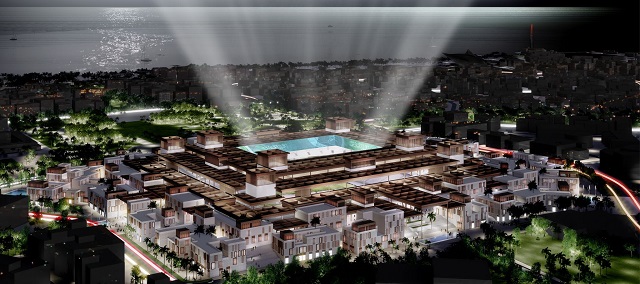
The scale, pricing and construction lessons emerging from the largest Fifa World Cup ever staged offer an early guide to what Saudi Arabia can expect when it hosts the tournament in 2034
The 2026 World Cup is being staged across 16 venues in the US, Canada and Mexico, with 48 nations competing over 39 days and 104 matches. It is the first World Cup hosted by three nations and the first expansion of the tournament format in 28 years, adding 16 teams and 40 matches to the previous edition. As the largest and most commercially valuable World Cup staged to date, it provides the first operational test of an expanded tournament format, and it is also the direct precedent for the next World Cup outside Europe, which will be Saudi Arabia’s 2034 edition.
One of the key changes in 2026 is how ticket prices are determined. Fifa introduced algorithmic dynamic pricing for the first time in 2026. Resale prices on SeatGeek reached a median of $1,291 by February, according to a report published Deutsche Bank Research Institute, and premium final seats at MetLife Stadium, with a face value of $6,730, were priced as high as $32,970 by early May. Final ticket prices for 2026 reached $8,680 on the resale market, more than five times the $1,606 recorded in Qatar in 2022.
Ticket backlash
GlobalData’s Sportcal analysis puts the official top price for the 19 July final at MetLife Stadium, renamed the New York New Jersey Stadium for the tournament, at $10,990, nearly seven times the top price for the 2022 final, against an original 2018 host bid estimate of $1,408 for the average final ticket. Sportcal also reports that Fifa president Gianni Infantino has defended the pricing on the basis of demand, citing more than 500 million applications for seven million available seats, while acknowledging that Fifa opted for a variable pricing system rather than full dynamic pricing. The scale of the increases has drawn regulatory scrutiny as well as public criticism: Sportcal reports that the attorneys general of New York and New Jersey opened an investigation into Fifa’s ticket practices in late May over allegations of artificially inflating prices, and that the Texas attorney general’s office launched a separate investigation two days before the opening match over complaints that fans were misled about seat locations for matches in Dallas and Houston. For Saudi organisers, this indicates that pricing structure and legal exposure, not only price level, will require early attention.
Room rates in several host cities rose by up to 300% immediately after the December group-stage draw, but by April, 80% of US hotel operators reported bookings below their initial forecasts, according to the Deutsche Bank report. New York bookings ran 65% below expectations and Seattle 80% below, while 70% of hotel operators cited visa and entry frictions as a primary drag on international demand. A comparable pattern occurred at the 1998 World Cup in France, where overnight non-resident hotel stays fell 13% year on year despite organisers forecasting an additional 500,000 tourists, an outcome economists describe as the “crowding-out effect”. Given that Saudi Arabia operates a more restrictive entry and visa regime than North America, this trend is directly relevant to the hotel construction programme already under way ahead of 2034 and Expo Riyadh 2030.
The Deutsche Bank report estimates the US GDP uplift from hosting at approximately 0.05%, describing it as negligible relative to the figures typically used to promote hosting bids. It cites research indicating that 12 of the last 14 World Cups produced net economic losses for host regions, and notes that Canada’s hosting costs, at roughly C$1.07bn, or C$82mn per match, function as prestige spending rather than economic stimulus. For Saudi Arabia, where World Cup hosting sits alongside Vision 2030 infrastructure spending and sovereign wealth-backed real estate, this evidence supports treating the tournament as one component of a broader diversification strategy rather than as a standalone driver of GDP growth.
Stadium pipeline
The scale of construction required for 2034 differs from the North American model, as Saudi Arabia is building most of its tournament infrastructure from new rather than adapting an existing base of major venues. According to the bid book submitted to Fifa in Paris in mid-2024, Saudi Arabia plans 15 stadiums across five host cities, with eight in Riyadh, four in Jeddah and one each in Al-Khobar, Abha and Neom. Of these, 11 are new builds, three are already under construction and four existing venues will be refurbished or temporarily expanded. The programme also includes 134 training sites across 10 additional cities, of which 73 are new facilities. The capital spending is needed to meet the requirement to deliver Fifa's minimum standard of 14 all-seater stadiums, including at least 80,000 seats for the opening and final matches, largely without the benefit of an existing large-stadium inventory.
The centrepiece is the King Salman International Stadium in north Riyadh, a 92,000-seat, 660,000-square-metre venue adjacent to King Abdulaziz Park, scheduled for completion in 2029 and confirmed to host both the opening match and the final. MEED has reported on construction awards in recent years for projects including the Public Investment Fund (PIF)-backed Roshn Group’s 45,000-seat stadium in southwest Riyadh, the New Murabba Stadium in the capital’s downtown redevelopment, the Prince Mohammed Bin Salman Stadium at Qiddiya, and the Aramco-backed stadium in Al-Khobar, alongside contract activity on the Jeddah Central stadium and early works at Dammam. A separate SR10.1bn ($2.7bn) Sports Ministry programme is under way to expand King Fahd Stadium to 92,000 seats and upgrade several other Riyadh and Dammam venues, with delivery timed so the same assets can also serve the 2027 AFC Asian Cup.
Set against the Deutsche Bank report’s finding that most recent World Cups have produced net economic losses for hosts, this level of capital commitment supports MEED’s assessment that the tournament should be considered within the context of Saudi Arabia’s wider Vision 2030 and tourism strategy rather than as a self-funding stimulus programme. It also indicates that the hotel demand risk identified in the North American data, where 80% of US operators reported bookings below forecast, warrants close monitoring given the parallel hotel and transport construction under way.
Commercial revenue
Fifa's commercial performance shows a favourable trend for hosts. According to the Deutsche Bank report, broadcast revenue for the 2023-26 cycle is projected to reach $4.2bn, while GlobalData’s Sportcal analysis puts media rights revenue closer to $3.9bn, up from $3.4bn in Qatar in 2022 and $3.1bn in Russia in 2018. Sportcal reports that Fifa has secured broadcast contracts with almost 80 international broadcasters across more than 220 territories, including late-cycle agreements with China’s CCTV and India’s Zee Entertainment, addressing earlier concerns about coverage gaps in the two most populous television markets. Total Fifa revenue for the 2023-26 cycle is put at $13bn by both reports, up from $6.5bn in the 2019-22 cycle, and Fifa has since raised its budget for the following four-year cycle to $14bn, having exceeded its 2022-26 target. Sponsorship revenue is put at $2.7bn by Sportcal, a record figure and at least $1bn above Qatar 2022, plus a further $670m from licensing. Fifa’s top commercial tier, comprising eight global partners including Adidas, Aramco, Coca-Cola, Qatar Airways and Visa, is reported to have generated $1.8bn and to be fully sold out.
Of particular relevance to the Gulf, the PIF features among Fifa’s third-tier regional supporters for the tournament, giving the kingdom’s sovereign wealth vehicle a direct commercial position in the World Cup eight years before it hosts the event itself. Much of this revenue growth is linked to the expansion from 32 to 48 teams, which raised the number of matches from 64 to 104. As 2034 will use the same 48-team format, Saudi Arabia can expect a comparable uplift in broadcast slots, sponsorship activations and data-driven revenue streams, including Fifa’s resale marketplace, which charges a 15% fee to both buyer and seller on each transaction. Fifa has also increased payments to participating federations for 2026, to $871m in total, including $2.5m a team, up from $1.5m in 2022, and qualification money of $10m, up from $9m, a trend Saudi organisers and the wider region’s federations will be tracking as the 2034 prize and participation pool is set.
Looking ahead
Overall, the North American tournament indicates that 2034 in Saudi Arabia is likely to generate strong commercial returns for Fifa and its sponsors, while ticket pricing backlash, regulatory scrutiny of ticket sales, softer-than-forecast hotel demand and limited direct GDP impact are realistic risks that require early planning rather than late-stage correction. With a construction programme worth billions of dollars already under way across Riyadh, Jeddah, Al-Khobar and Abha, the principal challenge for Saudi Arabia will be sequencing that investment so stadiums, hotels and transport links are ready in advance of 2034, while avoiding the demand mismatches and pricing disputes.
You might also like...
PIF's 2025 results back 2026-30 strategy shift
03 July 2026


A MEED Subscription...
Subscribe or upgrade your current MEED.com package to support your strategic planning with the MENA region’s best source of business information. Proceed to our online shop below to find out more about the features in each package.